Saturday, April 27, 2013

Can Anyone Stop Ohio State from Winning the Big Ten Championship?

After an undefeated 2012 campaign under new heard coach Urban Meyer, expectations are sky high in Columbus. No longer held back by NCAA post season sanctions, Ohio State sets their eyes on the Big Ten championship and are hopeful they can at the very least be in the discussion for the BCS Championship as well.

Braxton Miller scored 28 total touchdowns last season.
Leading the charge offensively for the Buckeyes is Heisman hopeful quarterback Braxton Miller. Miller was nothing short of dynamic last season accounting for over 3,300 yards of total offense and 28 total touchdowns (15 passing, 13 rushing) in 2012. The Buckeyes also have running back Carlos Hyde returning for his senior season. Hyde had a very solid season in 2012 rushing for close to 1,000 yards and scored 16 touchdowns on the ground. Miller and Hyde should prove to be a very scary 1-2 punch on the ground this season. But that does not mean they do not return talent at the wide receiver position either. They return both of their returning receivers in Philly Brown and Devin Smith. They both caught over 60 passes in 2012 and combined for 9 touchdown catches, Brown also chipped in two more scores on special teams. The Buckeyes have to be very happy that they return the nucleus of an offense that scored close to 40 points a game last season.

On the defensive side of the ball, the Buckeyes are losing a few key contributors along the defensive line to the NFL draft and graduation, most prominently  Johnathan Hankins who amassed 55 total tackles in 2012, including 4 tackles for loss, defensive end John Simon and his 9 sacks in 2012 are also going to need to be replaced. Linebackers Etienne Sabino and Nathan Williams who combined for over 80 tackles are also leaving for the NFL draft. Fortunately, the Buckeyes still return their leading tackler in senior linebacker Ryan Shazier. Shazier had over 100 tackles in 2012 with 17 tackles for loss, including 5 sacks, and he also had an interception to boot. The secondary will be lead by senior cornerback Christian Bryant and safety CJ Barnett.

From a personnel standpoint, Buckeyes fans have to be excited to have not only the core of the offense but also their two leading tacklers in Shazier and Bryant. Despite losing two key contributors on the defensive line in Hankins and John Simon, the Buckeyes still have tons of depth and young players ready to step up along the defensive line. However, you can have all the talent in the world but if you cant put it together on Saturdays you have no shot to contend for a Big Ten Championship.

Urban Meyer began his coaching career at Ohio State
with an undefeated season.
Looking at their schedule, the Buckeyes are set up very nicely for a run at not only a Leaders division championship, but the Big Ten crown as well. The Buckeyes open with two non conference home games in Buffalo and San Diego State before heading to the west coast to take on the California Golden Bears before heading home to take on Florida A&M before the first real test in my eyes on the schedule and that is a September 28th showdown in Columbus with the Wisconsin Badgers. If Ohio State can survive the Badgers they are set up for a very nice October home slate with the Iowa Hawkeyes and the Penn State Nittany Lions after a trip to Ryan Field to take on the Northwestern Wildcats.The Buckeyes will then start November with back to back road trips to Purdue and Illinois before hosting the Indiana Hooisers in the final home game of the season before finishing the regular season in the Big House to take on the hated Michigan Wolverines on November 30th.

In college football, a favorable schedule is at times the most important aspect to a successful season. I think that a 10+ win season is very possible, and may be expected by the Buckeye faithful in Columbus. With the biggest obstacles coming in Wisconsin and Michigan and both teams graduating their most dangerous offensive weapons in running back Montee Ball and quarterback Denard Robinson respectively. I do not see any team in the Big Ten that can match the offensive firepower of Braxton Miller and the Buckeyes. It should be an exciting season for you if you are Buckeye fan in 2013 and beyond.

- Josh Gamez
@itsjoshgamez

Wednesday, April 24, 2013

Can Butch Jones take Tennessee to the Top of the SEC?

The Tennessee Volunteers are arguably one of the most popular teams in college football. The Tennessee orange. The orange and white checkered endzone. Their mascot Smokey. Anyone who knows college football knows about the Tennessee Volunteers. However, being in the SEC, Tennessee has been stuck in the shadows of teams like Alabama, Florida, LSU, Auburn and others for quite some time. The last time that Tennessee won the National Championship was in 1998, when under Phillip Fulmer they beat the Florida State Seminoles in the first ever BCS Title Game.

Tennessee fans, players and alumni have been waiting anxiously to see their Volunteers fight back to the top of the SEC, and not only bring the SEC Championship home, but also bring another National Championship to Neyland Stadium.

Butch Jones has been coaching in the NCAA since 1990, where he was a defensive assistant at Rutgers. In 1992 Jones left Rutgers to become offensive coordinator for Wilkes. He was at Wilkes from 1992 to 1994, when he left for his alma mater Ferris State. There he assumed the same role he did at Wilkes.

In 1998 Butch found himself at Central Michigan University, where he'd move from coaching tight ends to running backs, and eventually become offensive coordinator from 2002 to 2004. Rich Rodriguez then brought Jones to West Virginia where he coached the wide receivers.

After two successful years at West Virginia, Butch got hired back to Central Michigan but this time as the head coach. There he led the Chippewas to an overall record of 27-13 over three years, and two MAC Championships. In 2010 Butch became the head coach of the Cincinnati Bearcats. In Cincinnati, Butch started off slow with a 4-8 record. In 2011 he improved to 10-3 and led the Bearcats to a Liberty Bowl victory over Vanderbilt, as well as a Big East Championship. In 2012 Butch led the Bearcats to a similar ending to the season, ending with a 9-3 record and another Big East Championship.

After much success at Cincinnati, on December 7, 2012 Butch announced that he was leaving Cincinnati and the Big East for Tennessee and the SEC.

The SEC will definitely bring quite a bit of competition Butch's way. He faced some top opponents while being the head coach at CMU and Cincinnati, but in the SEC he will consistantly face top opponents.

Tennessee has been waiting for a coach to bring them the success that they have been expecting, and Butch Jones can definitely be the coach to bring them that success. With an overall head coaching record of 50-27, he is not someone to be taken lightly. Granted teams like Alabama and LSU seem to be fine oiled machines that can't seem to lose, Tennessee has an overall record of 799–354–53. They more often see victories than defeats, and that's something that they'd like to see continue. I feel that Butch Jones is a man that will strive to lead Tennessee to continue improving that record, and to eventually get them the recruits and players good enough to not only become a top ten team, but to once again become National Champions.

- Jackson McNamara
@jacksonmcnamara

Tuesday, April 23, 2013

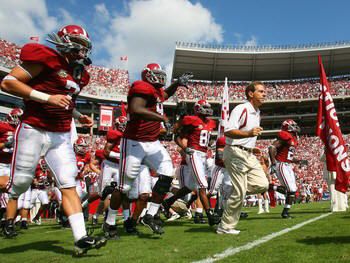
Can Nick Saban and the Crimson Tide Win a 3rd Consecutive National Championship?

Nick Saban and the Alabama Crimson Tide have been easily the most dominant program of the last 5 years, and arguably among the most dominant dynasties in college football history. With 3 national titles in the last 4 years (and 4 overall) it is hard to think of a more highly decorated coach in the nation than Nick Saban. His win loss record with the Tide speaks for itself (68-13 overall, with 2 SEC championships), he has really gotten to the point where winning games and making bowl games is not enough. He is now being judged on SEC and national championships.

So this brings up the question, can Saban and the Tide win a 3rd straight national championship? Well, as we have come to realize, in order to even have a shot at a national championship you must at the very least win 10 or 11 games in the regular season. So, having said that, you must first look at the schedule for the Tide; they open with Frank Beamer and the Virginia Tech Hokies as the Chick Fil-A Kickoff game, the Hokies who historically have been among the best in the ACC had a down season in 2012 and hope to have a much improved 2013 campaign. Next on the slate is a showdown with reigning Heisman Trophy winner Johnny Manziel and the Texas A&M Aggies in College Station, the only team to defeat the Crimson Tide in 2012. Johnny Football is electric, that's undeniable, however after losing starting left tackle Luke Joeckell to the NFL, it is hard to imagine Manziel duplicating his numbers from last year, this early test for the Tide and despite being a early match up, could potentially decide if the Tide is in fact on track for a 3 pete.

After facing the Aggies in College Station, they return to Tuscaloosa for two straight against the Ole Miss Rebels (and a phenomenal recruiting class) and then Georgia State on October 5th and 12th, before heading to Lexington to face the Kentucky Wildcats and new head man Mark Stoops on October 12th. Alabama then returns to Bryant-Denny Stadium for a three game SEC stretch, first facing off what many feel is a much improved Arkansas Razorback team on October 19th, then the Tennessee Volunteers the very next week and finishing up the home stand against Les Miles and the LSU Tigers in what has really become one of the highest profile, and most tightly contested SEC games year in year out. This growing rivalry between Saban's current squad and his former team has become a major determining factor in not only who wins the SEC, but also who may be competing in the national championship game in January.

After the Tide clashes with the Tigers, they travel to Starkville to take on Mississippi State, before taking on Chattanooga at home and they end the season against the in-state rival Auburn Tigers in the Iron Bowl.

Looking at the schedule, the Crimson Tide may have lucked out by avoiding two teams many feel could challenge the Crimson Tide for a SEC championship in the Florida Gators and the Georgia Bulldogs until potentially the SEC Championship game. But that's not saying that it is a cake walk for Saban this season. Far from it, competing in the SEC, without a doubt the most competitive conference in the country, you are in a battle every week. Luckily, the Crimson Tide returns many key starters to last seasons championship team, starting with quarterback AJ McCarron, who only threw for nearly 3,000 yards (2,933 to be exact) and 30 touchdowns (to only 3 interceptions), and of those 30 touchdown tosses, 11 were into the hands of electrifying wide receiver Amari Cooper, who some Alabama fans like to refer to as "Baby Julio" as a tribute to former Alabama stand out Julio Jones, Cooper had a solid freshmen season hauling in 59 passes for 1,000 yards.
TJ Yeldon
Leading the charge for the Tide's vaunted rushing attack is sophomore tail back TJ Yeldon, who despite splitting time with Eddie Lacy (who chose to forgo his senior season to enter the NFL draft) had over 1,100 rushing yards and 131 receiving yards for 13 total touchdowns (12 rushing), but they also are losing 3 members of arguably the best offensive line to the NFL draft (DJ Fluker, Barrett Jones and Chance Warmack) but if we have learned anything over the last few years about the Tide, it's that the young players waiting in the wings are no slouches either.

Despite losing defensive standouts like defensive linemen Jesse Williams, linebacker Nico Johnson and cornerback Dee Millner, the Tide still have an abundance of talent on the defensive side of the ball. Linebackers CJ Mosley and Trey DePriest both had very solid 2012 seasons, the two combined for 93 tackles, and with the recent history of Alabama linebackers stepping up and playing well (Rolando McClain, Courtney Upshaw and Dont'a Hightower in particular) I could very well see Mosley and DePriest stepping up and being very pivotal parts of the Tide defense this season.

By looking at the schedule and the returning contributes to both the offense and defense, I do feel the Tide can win a 3rd BCS championship, they have arguably the most talented roster top to bottom in the country, however with as unpredictable college football has been and the potential for injuries in the game of football it's hard to say anything is a given one way or another, however just by looking at the schedule and who is returning from last seasons championship team they have a very good chance of at the very least competing in a big time BCS bowl game, if not another championship game. One thing is for sure, we all will be very interested to see what happens once the Tide and the rest of the country begin competing in the 2013 college football season, preparing to make a run at a national championship.

Josh Gamez
@itsjoshgamez

Sunday, April 21, 2013

How Will Tommy Tuberville Do in Cincinnati?

The Cincinnati Bearcats have had quite a few flashes of greatness, followed by their coaches leaving for what they would consider a better opportunity at a bigger and/or better school. Brian Kelly coached the Bearcats from 2006 to 2009 with an overall record of 34-6, leading Cincinnati to bowl game victories as well as to a Sugar Bowl loss to the Florida Gators (although Kelly left the team at the conclusion of the season and didn't coach them for the Sugar Bowl loss). But Kelly left the Bearcats for what he considered his dream job, the head coaching position at Notre Dame. They also had Butch Jones coach them from 2010-2012 leading them to an overall record of 23-14 in his tenure. Jones led the Bearcats to a Liberty Bowl game victory over Vanderbilt. Butch Jones left to become head coach of the Tennessee Volunteers.

I'm sure Cincinnati is tired of being a stepping stone for coaches. I'm sure they're ready to have a coach stick with them and lead them to bigger and better things. Is that where Tommy Tuberville comes in? Tuberville has been head coaching some of the most storied college football programs dating back to 1995. Tuberville's first head coaching job was coaching the Ole Miss Rebels. He coached them from 1995 to 1998 and had an overall record there of 25-20.

He left Ole Miss for another SEC team, the Auburn Tigers. He coached for nearly a decade at Auburn, and led the Tigers to an SEC Championship. He also won the Bear Bryant Coach of the Year Award. Tigers fans loved watching Tuberville do something that no one had ever done before, beat their in-state rivals the Alabama Crimson Tide in six consecutive games. His overall record with the Auburn Tigers was 85-40.

After the 2008 season Tuberville left Auburn and the SEC, and jumped to the Texas Tech Red Raiders. Tommy led the Red Raiders to an overall 20-17 record with only one losing season, going 5-7 in 2011.

Tuberville led the Texas Tech Red Raiders
to an overall record of 20-17 during his tenure.
Tuberville promised he'd return to Texas Tech for the 2013 season, however he took a job with the Cincinnati Bearcats in December of 2012. The Bearcats' athletic director Whit Babcock is a good friend of Tommy's, whom he worked with at Auburn. Could that be the reason he decided to jump to Cincinnati?

It is in Tuberville's track record to imply he'd be sticking around, then leave not long afterward. For example at Ole Miss he made the announcement, "They’ll have to carry me out of here in a pine box," implying that he'd be staying at Ole Miss for quite sometime, but made a statement two days later that he was departing for Auburn.

Although Cincinnati players and fans would love to have a coach stay and finally build the Bearcats football team to the powerhouse that they know they can be, I highly doubt they care much about Tuberville's track record of implying he'd stick around only to leave not long afterward. Maybe in the future that may be on their concern list, but I'm sure that right now they're just wanting Tommy to bring the success he saw at Ole Miss, Auburn and Texas Tech to Nippert Stadium. Tommy is nearing 60 years old, so you would assume that he probably won't have much coaching left in him after a few years. Bearcats faithful are hoping to see Tuberville's last years head coaching be in Cincinnati, and maybe land them a National Championship or at least a couple of high profile bowl game victories. Does Tommy have what it takes to make Cincinnati a top college football team? I'd say so, but we'll just have to wait and see.

- Matt Lytle
@mattlytle

Saturday, April 20, 2013

A Short History of the BCS Championship

Not many things can stir up as much anger and debate among college football fans as these three letters: BCS. Bowl Championship Series. The governing body that looks over major college football and through a complicated process of polls, rankings (both human and computer) and what amounts to basically rocket science to most fans, they are able to crown a “national champion” even if it’s just in the BCS voters’ eyes.
               
Since the Bowl Championship Series took over for the equally controversial and flawed Bowl Alliance in 1998, they have been the governing body in crowning a national champion, and putting together all other bowl games. They have used the coaches and Harris polls as well as different computer polls to crown a national champion. Starting in 2006 however, they used the poll system in place to narrow down all the teams in Division I football from over 200 all the way down to 2 to play in what is known as the BCS National Championship game. Before the 2006 season, there wasn't a real “national championship” game. It was looked at among many some as a fictitious national championship at the time, but before the BCS National Championship Game tradition that began in 2006, the national championship was crowned by who won one of the 4 BCS bowls; Orange, Sugar, Rose and Fiesta, rotated annually.
               
In the Fiesta Bowl following the 1998 season, which is recognized as the first BCS national championship, #1 ranked SEC champion Tennessee were victorious over the 2nd ranked ACC champion Florida State Seminoles by a final score of 23-16. However, the Seminoles were victorious in the 1999 Sugar Bowl over the Big East winners Virginia Tech Hokies by a lopsided score of 46-29. The Seminoles would then make a 3rd straight appearance in the title game in 2000 as they faced the Big 12 Champion Oklahoma Sooners in the 2001 Orange Bowl. However, they would not be repeat champion as the Sooners prevailed over the Seminoles 13-2. This ended up being the last national championship appearance by legendary coach Bobby Bowden in a national championship game, he retired in 2009.
               
In the 2001 Rose Bowl, the top ranked Big East Champion Miami Hurricanes prevailed over the Big 12 co-champion Nebraska Cornhuskers in a dominating 37-14 performance. The U would then compete in the Fiesta Bowl the next year that was slated to be that seasons national championship against the Jim Tressel led, Big 10 co-champion Ohio State Buckeyes. Much like the hated Seminoles, the Hurricanes were not successful in the repeat attempt. They would fall to the Buckeyes 31-24 behind a phenomenal performance by Buckeyes quarterback Craig Krenzel. The next season, a familiar face in the national championship, the Oklahoma Sooners came in to the 2003 Sugar Bowl as the top ranked team in the country to face off the SEC champion LSU Tigers and head coach Nick Saban. Which was one the first major BCS controversies. In 2003 there were 3 one loss teams at the end of the season. The USC Trojans were also among those 3 teams with the best record in the nation. But LSU/Oklahoma was selected as the championship game. Many USC supporters actually protested the LSU/Oklahoma game. USC was victorious in the Rose Bowl that year 28-14 over the Michigan Wolverines. USC ended the year as #1 in the AP poll, but the Tigers were #1 in the coaches’ poll.
               
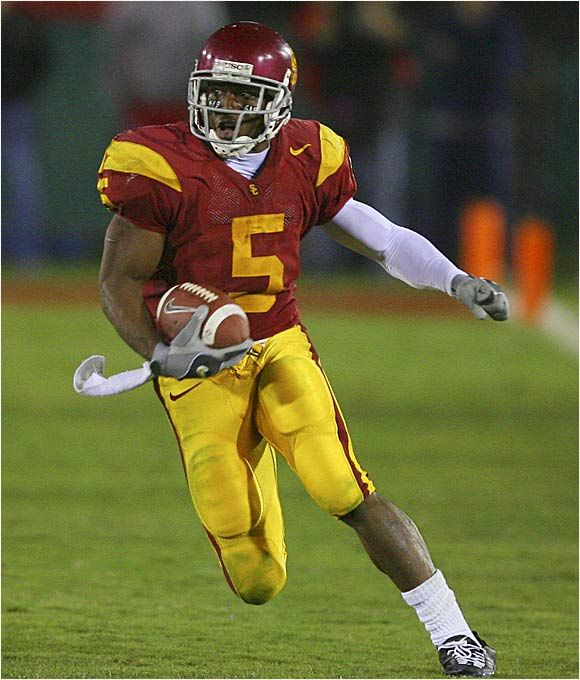
Reggie Bush was a big part of USC's success in 2004.
The very next season, technically doesn't exist anymore because of the sanctions against the University of Southern California because of the Reggie Bush scandal of a few years ago, when the #1 ranked Pac 10 champion Trojans faced the Oklahoma Sooners in the 2004 Orange Bowl. The 2004 national championship is still looked at as one of the most star studded of all time with 2003 Heisman trophy winning signal called Jason White dueling with the Trojans own signal caller Matt Leinart, who won the trophy the very next year. It also included two of the best college running backs of the last decade, the aforementioned Reggie Bush of USC, and the Sooners’ Adrian Peterson (who many feel may have been the best player in the country that season, but that’s a different discussion for a different day). This game also happened to feature 4 of the 5 finalists in the 2004 Heisman Trophy voting, the only excluded party being Utah’s signal called Alex Smith. Unfortunately, this offensive star power didn't equal a compelling game. With Jason White throwing 3 interceptions (the Sooners had 5 total turnovers) and Peterson rushing for a pedestrian 82 yards on 25 carries (for a very un-Peterson like 3.28 yards per carry), the Sooners just couldn't keep up with the high powered Trojan offense, behind the 5 touchdown passes from the Trojans’ Heisman Trophy winning quarterback (3 of which to wide receiver Steve Smith) and 525 yards of total offense, Pete Carroll’s Trojans cruised to a 55-19 victory and national championship.
               
The Trojans would be back in the championship again the very next season, with 2004 Heisman winner Matt Leinart and the 2005 Heisman winner, running back Reggie Bush leading the charge for the Pac 10 champs. They faced off against the Texas Longhorns and quarterback Vince Young in the 2005 Rose Bowl for the national championship. Unlike past years, there was not any doubt who the two best teams in the country were. The Longhorns and Trojans would then clash in what is still considered by many one of the greatest college football games of all time. The Trojans came in riding a 34 game winning streak, dating back to 2003, and USC’s Reggie Bush was named Heisman Trophy winner over the Longhorns’ Young (that trophy has since been vacated due to NCAA violations). The two teams were on a collision course since they were 1 and 2 in the polls all season. The hype for this game was insane, and boy did it deliver. The game was a battle all the way through. When USC scored, the Horns would answer back. Behind Vince Young’s 467 yards of total offense (267 passing, 200 rushing), and the 10 yard TD run on 4th and 5 to win the game is looked at as one of the greatest plays in college football history, the Longhorns would be crowned champions by a final score of 41-38 in a game that is still talked about today, and from a personal standpoint, that game took me from casual viewer of college football to a full-fledged fanatic. This was the final game in the previous rotating national championship format. The very next season, a separate BCS National Championship Game would be played after the 4 other BCS bowl games.
               
The first official BCS National Championship Game took place after the 2006 season. It featured the #1 ranked Ohio State Buckeyes and a new face on the BCS stage; the Florida Gators. After winning the SEC championship game against the Arkansas Razorbacks, the Gators leapfrogged USC and Michigan in the BCS rankings, stamping their ticket to University of Phoenix Stadium to face the Buckeyes. Which was another BCS controversy. Many people wanted a rematch between the unbeaten Buckeyes, and rival Michigan Wolverines who had an all-time great game a few weeks prior. But, because of the Wolverines idleness while the Gators won the SEC championship game, which is what put the Gators over the top in many people’s eyes, the Buckeyes and Gators faced off for the national championship in Glendale, Arizona, for the first time in each schools’ history. The 12-1 Gators were led by quarterback Chris Leak, and the Buckeyes came in with Heisman Trophy winning quarterback Troy Smith. The Gators defense was stingy as stingy can be, they held the Heisman Trophy winner to 4 completions for 35 yards and an interception, and only 82 yards of total offense from the Buckeyes offensively (they did however give up a phenomenal return touchdown to Ted Ginn Jr. in the opening seconds of the game), the Gators cruised to a 41-14 win, and began a dominating stretch of National Championship Game victories by SEC teams.
               
The Buckeyes would return to the championship game the next season, only this time matched up with Les Miles’ LSU Tigers. This was the 2nd bowl game match up between Tressell and Miles. The first taking place in the 2004 Alamo Bowl. Behind 4 touchdown passes from Tigers quarterback Matt Flynn, the Buckeyes would fall for the second straight year in the national championship. The next year, the Florida Gators, this time lead by 2007 Heisman Trophy winning quarterback, and one of the most polarizing figures in American sports history, Tim Tebow. While the Sooners and 2008 Heisman Trophy winner, Sam Bradford and the highest scoring offense in NCAA history. The second time that the last two Heisman quarterbacks faced off in the BCS championship. Given the potency of both offenses (Florida averaged over 45 points per game that season, and Oklahoma 54) it was a relatively low scoring game, the Gators would prevail 24-14, for their second championship in 3 years.
               
Nick Saban's Crimson Tide has been dominant in title games.
The last 4 years, the BCS National Champion has come from the state of Alabama. Nick Saban’s Alabama Crimson Tide, with one of the most dominant run games in recent memory lead by future first round NFL draft picks; Mark Ingram (that seasons Heisman winner) and Trent Richardson leading the charge offensively, prevailed over the Texas Longhorns 37-21. The next season, behind the dynamic Cam Newton, the Tide’s in state rival the Auburn Tigers won the SEC (and one of the most impressive Iron Bowl comebacks of all time) and defeated the Oregon Ducks in the championship game, behind 254 rushing yards, the Tigers were victorious 22-19 on a last second field goal.
               
The next season might have been the most controversial yet. With only one undefeated team, Les Miles and the LSU Tigers the big debate arose again; rematch or new opponent. The Alabama Crimson Tide, sporting an 11-1 record, and the only loss being a 9-6 overtime loss to the top ranked Tigers and the also one loss Oklahoma State Cowboys were looked at as the two potential opponents for the Tigers in New Orleans for the BCS National Championship Game. Alabama was announced as the #2 team, which created much debate among fans that not only was the championship game a rematch, but also a rematch between teams in the same division of the SEC. Alabama would go on to shut out the Tigers 21-0 for their second championship in 3 years. The Tide would win again this past season in convincing fashion once again 42-14 over unbeaten Notre Dame.
               
The BCS system is far from perfect, but it’s not the worst possible way to crown a championship. However, the popular idea of a playoff will in fact come into play in 2014 with a brand new 4 team playoff to crown a champion. Only time will tell if that is the end all be all of crowning a champion, but one thing is for sure, regardless, we will more than likely still watch and be enthralled in everything national championship. After all, that’s we all love college football right?

- Josh Gamez
@itsjoshgamez

Thursday, April 18, 2013

How Will Bret Bielema Fair as Arkansas Head Coach?

Bret Bielema has been in the college football world far longer than (what I assume) most people realize. He played for the Iowa Hawkeyes, but also served as an assistant coach there from 1993 to 2001. In 2002 he became the co-defensive coordinator for the Kansas State Wildcats. He kept that position until 2004 when he got hired by the Wisconsin Badgers to serve as the defensive coordinator as well. After one year as the defensive coordinator at Wisconsin, Barry Alvarez announced his retirement from coaching, and Bielema became the head coach of the Badgers.

Bielema was quite impressive his first year at Wisconsin. Not only did he lead them to a Capital One Bowl victory over the Arkansas Razorbacks, but he also led them to a 12-1 record. Bret also led Wisconsin to a victory over the #1 ranked Ohio State Buckeyes.

Bielema ended up winning 17 of his first 18 games as head coach of the Badgers, which is the second-best start to a head coaching career in the Big Ten, only seconded by former Michigan coach Fielding Yost.

Between 2006 and 2012, Bret racked up 68 wins as the Wisconsin head coach, and only lost 24 games. He coached the Badgers in six bowl games, but only won two. Two of the losses were in the Rose Bowl.

As I mentioned before, Bret did lead Wisconsin to a victory over the Buckeyes in his first year, but that was the one and only victory he saw as Wisconsin head coach. Overall he went 1-5 against Ohio State.

Although Bret did fair very well as head coach of the Badgers, never having a losing season, now he finds himself with the Arkansas Razorbacks in the very impressive SEC. In the Big Ten Bielema found himself against many tough matchups, including Ohio State, Michigan, Michigan State, Nebraska and his alma mater Iowa. But some may argue that the SEC is a tougher conference. We won't get into comparing conferences right now, but he will find himself in games against the likes of the Alabama Crimson Tide, the Auburn Tigers the Florida Gators and many others.

I'd say it's safe to say that it's going to be tough for Bielema to see the same success he saw his first year as Wisconsin head coach, but that doesn't mean it can't happen. However, he is playing Florida, Alabama and LSU at their home stadiums.

Bielema has an quite the impressive coaching career, and I expect to see the same style and same winning attitude out of him at Arkansas, but the SEC is a little bit different than the Big Ten. Will it be a difference that benefits Bielema or hurts him however, we will just have to wait and see.

- Matt Lytle
@mattlytle

Wednesday, April 17, 2013

Will Gary Andersen Do Well With Wisconsin?

In December of 2012 Bret Bielema left his 8-5 Wisconsin Badgers and took the job of the head coach of the Arkansas Razorbacks. On December 19, 2012 it was announced that Gary Andersen would be leaving the Utah State Aggies, whom he led to an 11-2 record in 2012, to become the new head coach of the Wisconsin Badgers.

Andersen began his coaching career as a defensive coordinator. In fact, he was the defensive coordinator of the Utah Utes, who in 1008 went undefeated and defeated the Alabama Crimson Tide in the 2009 Sugar Bowl. In 2009 Andersen became the head coach of the Utah State Aggies.

His first two years coaching the Aggies Andersen went 4-8. in 2011 he improved their overall record to 7-6, and finally as noted in this article, in 2012 he led them to an 11-2 year.

Can Gary bring the success he found with Utah State in the Mountain West to the Wisconsin Badgers in the Big Ten? It's a good and fair question. Obviously he is going to find tougher competition in the Big Ten, most notably the Ohio State Buckeyes, Michigan Wolverines, Michigan State Spartans, and Nebrask Cornhuskers, among others.

Andersen is a defensive coach, which isn't a bad thing, especially in the Big Ten. He will be competing against other top defensive coaches such as Brady Hoke (of the Michigan Wolverines) who has defensive coordinator Greg Mattison (who is known for coaching the phenomenal defense of the Baltimore Ravens).

The Badgers didn't do as well as many expected in 2012, so I think Wisconsin will be looking to come out on fire and try to take the Big Ten Leaders Division Title, however with a new coach you're never really sure how a team will perform. As we get closer to fall we will be able to see what kind of shape Gary is whipping his new team into. And until then the Badgers can know that they have a leader that although it may not seem to matter a whole lot, seems to be a stand up guy in that after he made the decision to leave Utah State, he called each one of his players individually to let them know about his decision.

- Matt Lytle
@mattlytle