Not many things can stir up as much anger and debate among college football fans as these three letters: BCS. Bowl Championship Series. The governing body that looks over major college football and through a complicated process of polls, rankings (both human and computer) and what amounts to basically rocket science to most fans, they are able to crown a “national champion” even if it’s just in the BCS voters’ eyes.
Since the Bowl Championship Series took over for the equally controversial and flawed Bowl Alliance in 1998, they have been the governing body in crowning a national champion, and putting together all other bowl games. They have used the coaches and Harris polls as well as different computer polls to crown a national champion. Starting in 2006 however, they used the poll system in place to narrow down all the teams in Division I football from over 200 all the way down to 2 to play in what is known as the BCS National Championship game. Before the 2006 season, there wasn't a real “national championship” game. It was looked at among many some as a fictitious national championship at the time, but before the BCS National Championship Game tradition that began in 2006, the national championship was crowned by who won one of the 4 BCS bowls; Orange, Sugar, Rose and Fiesta, rotated annually.
In the Fiesta Bowl following the 1998 season, which is recognized as the first BCS national championship, #1 ranked SEC champion Tennessee were victorious over the 2nd ranked ACC champion Florida State Seminoles by a final score of 23-16. However, the Seminoles were victorious in the 1999 Sugar Bowl over the Big East winners Virginia Tech Hokies by a lopsided score of 46-29. The Seminoles would then make a 3rd straight appearance in the title game in 2000 as they faced the Big 12 Champion Oklahoma Sooners in the 2001 Orange Bowl. However, they would not be repeat champion as the Sooners prevailed over the Seminoles 13-2. This ended up being the last national championship appearance by legendary coach Bobby Bowden in a national championship game, he retired in 2009.
In the 2001 Rose Bowl, the top ranked Big East Champion Miami Hurricanes prevailed over the Big 12 co-champion Nebraska Cornhuskers in a dominating 37-14 performance. The U would then compete in the Fiesta Bowl the next year that was slated to be that seasons national championship against the Jim Tressel led, Big 10 co-champion Ohio State Buckeyes. Much like the hated Seminoles, the Hurricanes were not successful in the repeat attempt. They would fall to the Buckeyes 31-24 behind a phenomenal performance by Buckeyes quarterback Craig Krenzel. The next season, a familiar face in the national championship, the Oklahoma Sooners came in to the 2003 Sugar Bowl as the top ranked team in the country to face off the SEC champion LSU Tigers and head coach Nick Saban. Which was one the first major BCS controversies. In 2003 there were 3 one loss teams at the end of the season. The USC Trojans were also among those 3 teams with the best record in the nation. But LSU/Oklahoma was selected as the championship game. Many USC supporters actually protested the LSU/Oklahoma game. USC was victorious in the Rose Bowl that year 28-14 over the Michigan Wolverines. USC ended the year as #1 in the AP poll, but the Tigers were #1 in the coaches’ poll.
 |
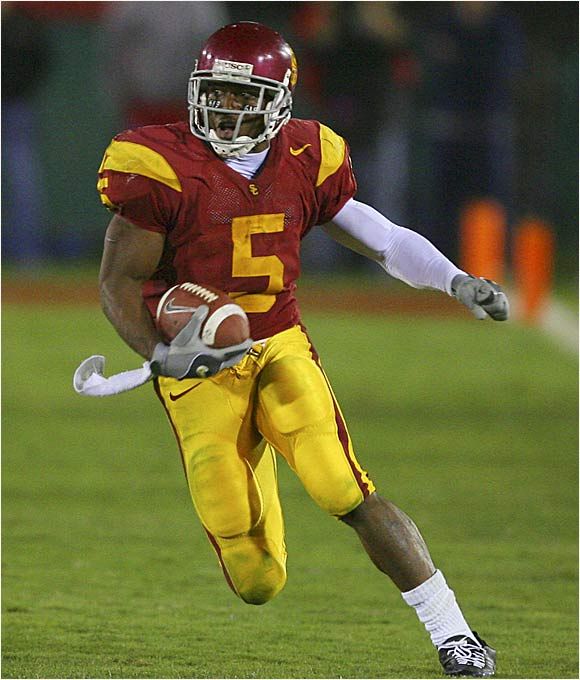
| Reggie Bush was a big part of USC's success in 2004. |
The very next season, technically doesn't exist anymore because of the sanctions against the University of Southern California because of the Reggie Bush scandal of a few years ago, when the #1 ranked Pac 10 champion Trojans faced the Oklahoma Sooners in the 2004 Orange Bowl. The 2004 national championship is still looked at as one of the most star studded of all time with 2003 Heisman trophy winning signal called Jason White dueling with the Trojans own signal caller Matt Leinart, who won the trophy the very next year. It also included two of the best college running backs of the last decade, the aforementioned Reggie Bush of USC, and the Sooners’ Adrian Peterson (who many feel may have been the best player in the country that season, but that’s a different discussion for a different day). This game also happened to feature 4 of the 5 finalists in the 2004 Heisman Trophy voting, the only excluded party being Utah’s signal called Alex Smith. Unfortunately, this offensive star power didn't equal a compelling game. With Jason White throwing 3 interceptions (the Sooners had 5 total turnovers) and Peterson rushing for a pedestrian 82 yards on 25 carries (for a very un-Peterson like 3.28 yards per carry), the Sooners just couldn't keep up with the high powered Trojan offense, behind the 5 touchdown passes from the Trojans’ Heisman Trophy winning quarterback (3 of which to wide receiver Steve Smith) and 525 yards of total offense, Pete Carroll’s Trojans cruised to a 55-19 victory and national championship.
The Trojans would be back in the championship again the very next season, with 2004 Heisman winner Matt Leinart and the 2005 Heisman winner, running back Reggie Bush leading the charge for the Pac 10 champs. They faced off against the Texas Longhorns and quarterback Vince Young in the 2005 Rose Bowl for the national championship. Unlike past years, there was not any doubt who the two best teams in the country were. The Longhorns and Trojans would then clash in what is still considered by many one of the greatest college football games of all time. The Trojans came in riding a 34 game winning streak, dating back to 2003, and USC’s Reggie Bush was named Heisman Trophy winner over the Longhorns’ Young (that trophy has since been vacated due to NCAA violations). The two teams were on a collision course since they were 1 and 2 in the polls all season. The hype for this game was insane, and boy did it deliver. The game was a battle all the way through. When USC scored, the Horns would answer back. Behind Vince Young’s 467 yards of total offense (267 passing, 200 rushing), and the 10 yard TD run on 4th and 5 to win the game is looked at as one of the greatest plays in college football history, the Longhorns would be crowned champions by a final score of 41-38 in a game that is still talked about today, and from a personal standpoint, that game took me from casual viewer of college football to a full-fledged fanatic. This was the final game in the previous rotating national championship format. The very next season, a separate BCS National Championship Game would be played after the 4 other BCS bowl games.
The first official BCS National Championship Game took place after the 2006 season. It featured the #1 ranked Ohio State Buckeyes and a new face on the BCS stage; the Florida Gators. After winning the SEC championship game against the Arkansas Razorbacks, the Gators leapfrogged USC and Michigan in the BCS rankings, stamping their ticket to University of Phoenix Stadium to face the Buckeyes. Which was another BCS controversy. Many people wanted a rematch between the unbeaten Buckeyes, and rival Michigan Wolverines who had an all-time great game a few weeks prior. But, because of the Wolverines idleness while the Gators won the SEC championship game, which is what put the Gators over the top in many people’s eyes, the Buckeyes and Gators faced off for the national championship in Glendale, Arizona, for the first time in each schools’ history. The 12-1 Gators were led by quarterback Chris Leak, and the Buckeyes came in with Heisman Trophy winning quarterback Troy Smith. The Gators defense was stingy as stingy can be, they held the Heisman Trophy winner to 4 completions for 35 yards and an interception, and only 82 yards of total offense from the Buckeyes offensively (they did however give up a phenomenal return touchdown to Ted Ginn Jr. in the opening seconds of the game), the Gators cruised to a 41-14 win, and began a dominating stretch of National Championship Game victories by SEC teams.
The Buckeyes would return to the championship game the next season, only this time matched up with Les Miles’ LSU Tigers. This was the 2nd bowl game match up between Tressell and Miles. The first taking place in the 2004 Alamo Bowl. Behind 4 touchdown passes from Tigers quarterback Matt Flynn, the Buckeyes would fall for the second straight year in the national championship. The next year, the Florida Gators, this time lead by 2007 Heisman Trophy winning quarterback, and one of the most polarizing figures in American sports history, Tim Tebow. While the Sooners and 2008 Heisman Trophy winner, Sam Bradford and the highest scoring offense in NCAA history. The second time that the last two Heisman quarterbacks faced off in the BCS championship. Given the potency of both offenses (Florida averaged over 45 points per game that season, and Oklahoma 54) it was a relatively low scoring game, the Gators would prevail 24-14, for their second championship in 3 years.
 |
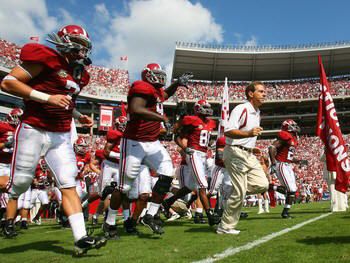
| Nick Saban's Crimson Tide has been dominant in title games. |
The last 4 years, the BCS National Champion has come from the state of Alabama. Nick Saban’s Alabama Crimson Tide, with one of the most dominant run games in recent memory lead by future first round NFL draft picks; Mark Ingram (that seasons Heisman winner) and Trent Richardson leading the charge offensively, prevailed over the Texas Longhorns 37-21. The next season, behind the dynamic Cam Newton, the Tide’s in state rival the Auburn Tigers won the SEC (and one of the most impressive Iron Bowl comebacks of all time) and defeated the Oregon Ducks in the championship game, behind 254 rushing yards, the Tigers were victorious 22-19 on a last second field goal.
The next season might have been the most controversial yet. With only one undefeated team, Les Miles and the LSU Tigers the big debate arose again; rematch or new opponent. The Alabama Crimson Tide, sporting an 11-1 record, and the only loss being a 9-6 overtime loss to the top ranked Tigers and the also one loss Oklahoma State Cowboys were looked at as the two potential opponents for the Tigers in New Orleans for the BCS National Championship Game. Alabama was announced as the #2 team, which created much debate among fans that not only was the championship game a rematch, but also a rematch between teams in the same division of the SEC. Alabama would go on to shut out the Tigers 21-0 for their second championship in 3 years. The Tide would win again this past season in convincing fashion once again 42-14 over unbeaten Notre Dame.
The BCS system is far from perfect, but it’s not the worst possible way to crown a championship. However, the popular idea of a playoff will in fact come into play in 2014 with a brand new 4 team playoff to crown a champion. Only time will tell if that is the end all be all of crowning a champion, but one thing is for sure, regardless, we will more than likely still watch and be enthralled in everything national championship. After all, that’s we all love college football right?
- Josh Gamez
@itsjoshgamez